TechTool
» Statics 24
» Statics 23
» Statics 22
» Statics 21
» Statics 20
» Statics 19
» Statics 18
» Statics 17
» Statics 16
» Statics 15
» Statics 14
» Statics 13
» Statics 12
» Statics 11
» Statics 10
» Statics 9
» Statics 8
» Statics 7
» Statics 6
» Statics 5
» Statics 4
» Statics 3
» Statics 2
» Statics 1

The World of Statistics and Probability (1)
By Dr. Magdi Abadir, PhD
Article 24: Discrete random Variables (1)
1. Introduction
Consider the following game: One tows a dice. If he gets the number (1), he wins $2. If he gets any other odd number, he wins $0.5. If he gets any even number, he loses $1. Suppose now that he goes on playing this game a great number of times. What would be the odds that he will be gaining any money? And if he does, what would his expected gains be?In that example, the sum he wins is said to be a random variable, denoted by X. Therefore, X can take the following set of values: {2,0.5,-1}. The probability of X equaling any of these values is known as the law of probability of the random variable. We first set a table showing all possible outcomes:
| Outcome | 1 | 2 | 3 | 4 | 5 | 6 |
| Gain X $ | 2 | -1 | 0.5 | -1 | 0.5 | -1 |
| X | 2 | 0.5 | -1 |
| P(X) |  |
 |
 |
This is an example of a discrete random variable, where X can only take some specific values. The law of probability takes the general form:


Obviously, the values of any probability are positive, and the sum of all probabilities is 1. In the next section, we deal with determining the expected gain (or loss).
2. Expectation (Average value)
The gain expectation, or the average value of X is calculated from the following formula:



This means that over the long run, the game yields a net profit of zero for the player: He neither wins nor loses. This is called a fair game.
Let us now move to a game of Roulette. There are 38 sockets, of which 18 are black (B), 18 red (R) and 2 green (G). If the ball sets on the green socket, then no players win and all bets go to the casino. The law of probability is given in the following table.

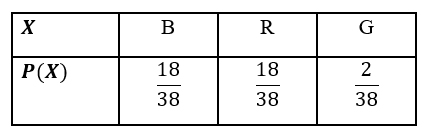
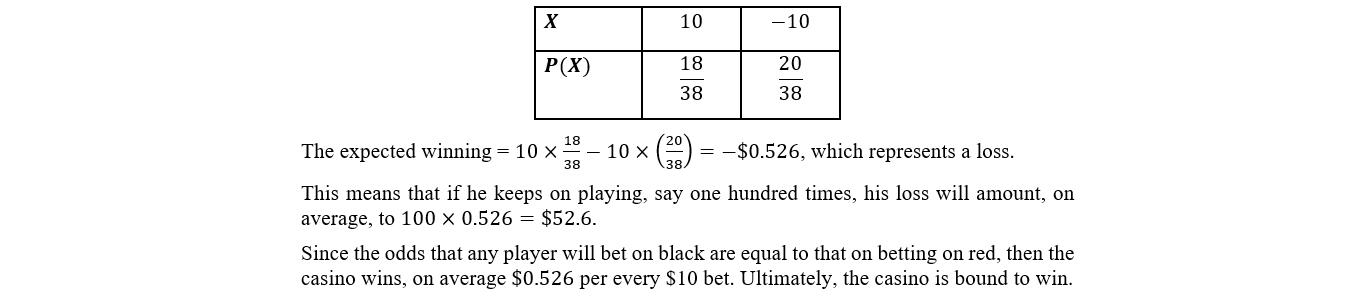
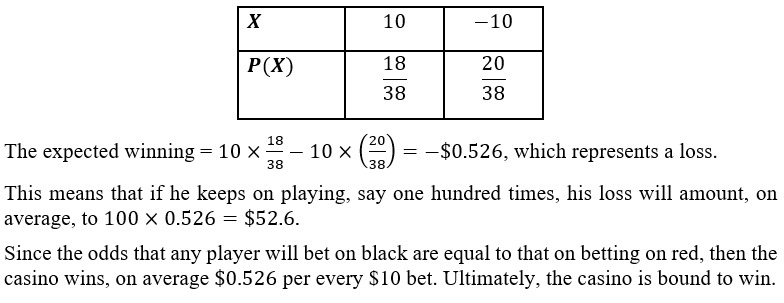
Suppose a player bets $10 at a time on black color, then he only wins if the ball hits a black socket, otherwise he loses. His winning probability is as follows:
Reference
(1) W.J. DeCoursey (2003) “Statistics and Probability for Engineering Applications” Ed. Newnes, pages 84 – 88.
| Dr. Magdi Fouad Abadir, Ph. D.: Dr. M. F. Abadir is currently a professor with the Chemical Engineering Department at the Faculty of Engineering, University of Cairo, Egypt. His major interests are in the fields of high temperature science and technology. During his career, he has supervised more than 110 MSc and PhD theses and published more than a hundred papers mostly in international peer review journals. He currently teaches courses in High Temperature Technology and Industrial Statistics. He is also a consultant for several industrial businesses. |


